 AF1
AF1 


The
WASHINGTON WOLFPACK
#OneCommunity

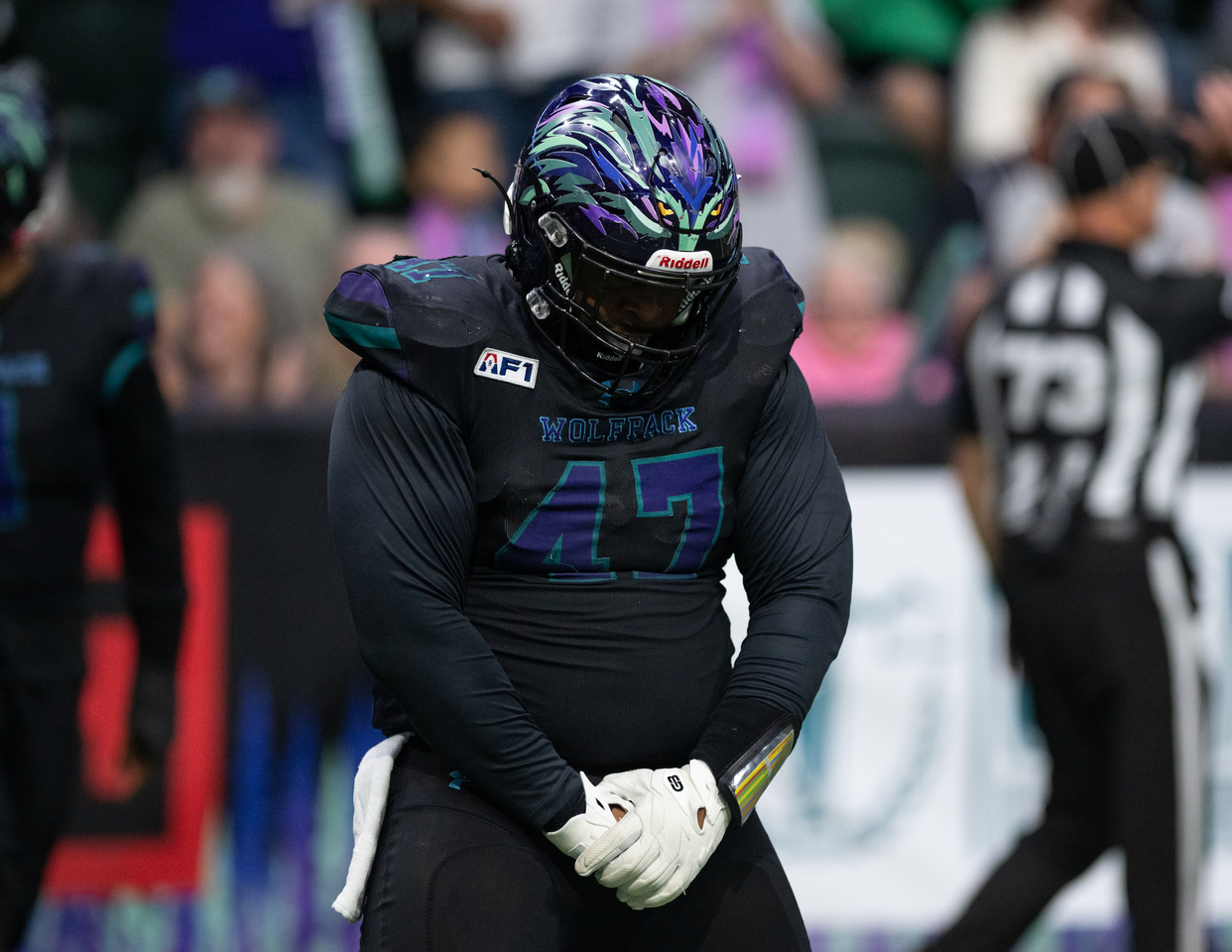
At 35 years old, Undra Hendrix lowers his shoulder like a man who doesn't know how to quit. In talking with him, I got to know the fun personality that is Undra Hendrix. However, he's also a man who knows when to be serious. He's a man of faith, a mentor, a coach, and a fiery competitor.
Hendrix has started every game for the Washington Wolfpack as their fullback. He’s the Wrecking Ball, blocking and running with the violence of a much younger man. Catching passes, grinding out yards, and helping a team that no one gave enough credit to. Now the playoffs are here, and they are the dark horse. And Hendrix, older than almost everyone around him, is still at the center of it all.
“I know I’m the best fullback in this league,” he says, the words quiet but absolute. “With the minimized carries and the catches, the stuff that I’ve done this year, I think I’ve shown in the blocking that, hey, I’m the best fullback in this league. The Wrecking Ball is still here.” It's the type of confidence earned.
This is not a story about a man who refuses to grow old. It is a story about a man who has already lost enough to know what loss feels like in the bones, and still chooses, every morning, to rise.
Last September, his girlfriend passed away. The grief did not arrive politely. It opened doors he never wanted to walk through, including mental health battles. The kind that make the world feel thin and dangerous. He does not dress it up when talking about it.
“Without God, I wouldn’t be here. He is the reason that I’m here. He’s the reason why I’m breathing, and He’s the reason why I’m playing football.”
That sentence is the axis of everything. Faith is not a slogan for Undra Hendrix. It is the reason the story continues.
He was born in Dallas, raised in Oak Cliff, South Dallas. When he was eight, his single mother moved them to Grand Prairie, then Irving. They lived on government assistance. Yet the same year Undra walked across a high-school stage, his mother walked across a college one. She became the first and loudest proof to him that a person can keep moving even when the ground is uneven. To this day she remains one of his biggest role models and inspirations. She keeps good company, as he also cited former President Barack Obama as a role model for the changes he brought and how he never said a bad thing about anybody.
Football found him after that move as he entered peewee football. He started football as a running back and quarterback. Then, in his own words, the “chubby stage” in fifth and sixth grade forced him onto the offensive line. He moved back to quarterback and linebacker in middle school. At Ranchview High School, he was a heavily recruited linebacker. Michigan State, Notre Dame, and others all showed interest. However, the spread offense rewrote Texas high-school football. His coach asked him to move to the defensive line. He still became All-State. The Division I offers never fully came after that, though. The defensive line move required added weight, which gave him less speed.
Adapt or get left behind. He adapted. He's always adapted.
At Hardin-Simmons, a Division III school in Abilene, he became an All-American defensive tackle and still owns the squat record of 715 pounds. The NFL regional combine came and went with silence. So he signed with the Laredo Rattlesnakes in 2013, then the Amarillo Venom, where a coach looked at him and simply said, “Undra, you’re gonna run the ball this year.” He ran for 14 touchdowns. Hendrix’s journey continued. All-league, championship losses, and more teams. Jacksonville, Vegas (which folded), two years with the Tampa Bay Storm beside NFL veterans. Back to Amarillo and other indoor stops. The brutal economics of indoor football.
What kept him going?
“You just gotta love the grind. Football’s supposed to be fun. If you’re gonna win, you’re gonna prepare to win. If you don’t prepare to win, you’re gonna lose. It’s simple.”
He watched T.T. Tolliver play into his mid-40s. Toliver became a Super Bowl winner, an Arena Bowl champion, bald and smiling and still dangerous. Tolliver’s message became Hendrix’s own: “Just ’cause I’m old, just ’cause I’m bald, watch, I can still do this.”
He has two sons now, Undra III, 13, and Jeremiah, 11. They watch film with him. They do not spare feelings.
“They’ll be like, hey, man, you missed the cut. You missed the block.” Hendrix loves every minute of it.
He plays for them. He lit up when talking about them. The excitement of their interest in football, just spending time with them. Hendrix loves everything about them.
He also plays for the kids of West Texas Elite 7-on-7, the program he started around 2019 as a side hustle, training five-to-eleven-year-olds in Amarillo. It grew into something larger than he imagined. They have more than six championships across age groups, a nationals runner-up finish, and over fifty players sent to college programs. One of his kids, Jackson Lawyer, who he’s worked with since age twelve, moved from tight end to offensive line and is now set to be one of the top tackles in the 2028 class. Hendrix says the kid will play in the NFL.
The original vision was never this big. He just needed a side job. What he found was family in a place people often misunderstand.
“I just love being around them, trying to change the next generation.”
The lessons he pours into them are the same ones that saved him.
“First thing, most important, you’ve got to have God in your life. Another important thing is mental health. For me, too many young kids are committing suicide. So for me it is teaching them how to have a vision to get out.”
Grades, recruiting profiles, dead periods and open periods. The quiet truth that a Division III path, like his own, can still lead somewhere meaningful are all lessons he passes down. He has watched former teammates and coaches rise. Guys like Scotty Walden, once his starting safety, is now the head coach at UTEP. The first All-American listed in another coach’s bio is Hendrix himself. The game keeps circling back, offering new ways to give.
This past season he was offensive coordinator for the Dallas Bulls. The head coach asked him to come out of retirement, and he posted about it on social media. An old teammate, now an agent, connected him with Washington Wolfpack head coach JR Wells. Film was sent, and a door opened, even at the age of 35.
He has started every game. He ranks among the league’s top rushers. He leads all fullbacks in receiving. More than numbers, he has brought presence to a player-led team under a coach whose energy and standards remind him of the best men he has known. Especially Julian Reese in Amarillo, a pastor who never cursed, demanded greatness, and loved his players enough to pull them aside and tell them the quiet truth when they fell short.
Off the field, he is simply Dre. He reads. He loses himself in Netflix documentaries, watches Law & Order: SVU, Grey’s Anatomy, and the chick flicks he first put on when his boys were little. He loves being outside. He is a die-hard Dallas Cowboys fan with such a passion that when they lose, it’s not a good week. In high school, he even portrayed a character from High School Musical.
“I’m single. If a woman wants to watch Dreamgirls, I’m her guy,” says Hendrix with a grin. In the thirty minutes I talked with him, that’s who he is. He’s happy, he’s energetic, he’s passionate, he has strong faith, and he’s somebody you can’t help but want to sit down and have a conversation with.
He talks trash on the field at times but is quick to show his love and support as well. When the pads finally come off for good, the answer to what he hopes people remember is simple, yet profound.
“When Dre put the pads on, he was a dog. He was gonna go 100 miles an hour. Whatever he lacked with athleticism or whatever, he was gonna put 110% in what he was gonna do. And as just a person, he’s Dre. Sometimes he’s gonna talk his shit, sometimes he’s gonna just be quiet. But he’s going to love you and be there for you.”
The trials, losing his girlfriend, the mental health battles, the folding teams, the single-mother upbringing, have not defined the ending. They have forged the man who can still look a younger teammate in the eye and say the grind is worth it.
The Washington Wolfpack enter these playoffs as underdogs. Hendrix embraces it completely.
“We are the dark horse. Everybody can pick against us. I’m cool with it.”
He believes in March Madness magic. He believes in the second chance Beaumont’s loss handed them. Most of all, he believes in the quiet guiding hand of faith:
“Whatever you do in life, and you put 100% effort into it, God’s gonna bless that.”
From the Oak Cliff streets to All-State, from a 715-pound squat record to a decade of indoor collisions, from building a youth program that has changed dozens of lives to suiting up again at 35, Undra Hendrix is still moving. Still leading. Still loving the game and the people inside it. His story is not about defying age. It is about refusing to let circumstances define the ending.
When the final whistle eventually sounds, the legacy will not be measured only in yards or touchdowns or records. It will be measured in two boys who learned that their father still gets up after the missed block. In West Texas kids who learned that vision and God can carry them farther than any offer list. In the simple, unbreakable truth he lives every time he puts the pads on. That the grind never ends when you love it, and when you trust the One who put you here.
The Wolfpack may be the dark horse this postseason. But Undra Hendrix doesn’t mind being an underdog. Because the underdogs, when anchored by faith and fueled by love for the grind, have a funny way of writing the most unforgettable chapters.
